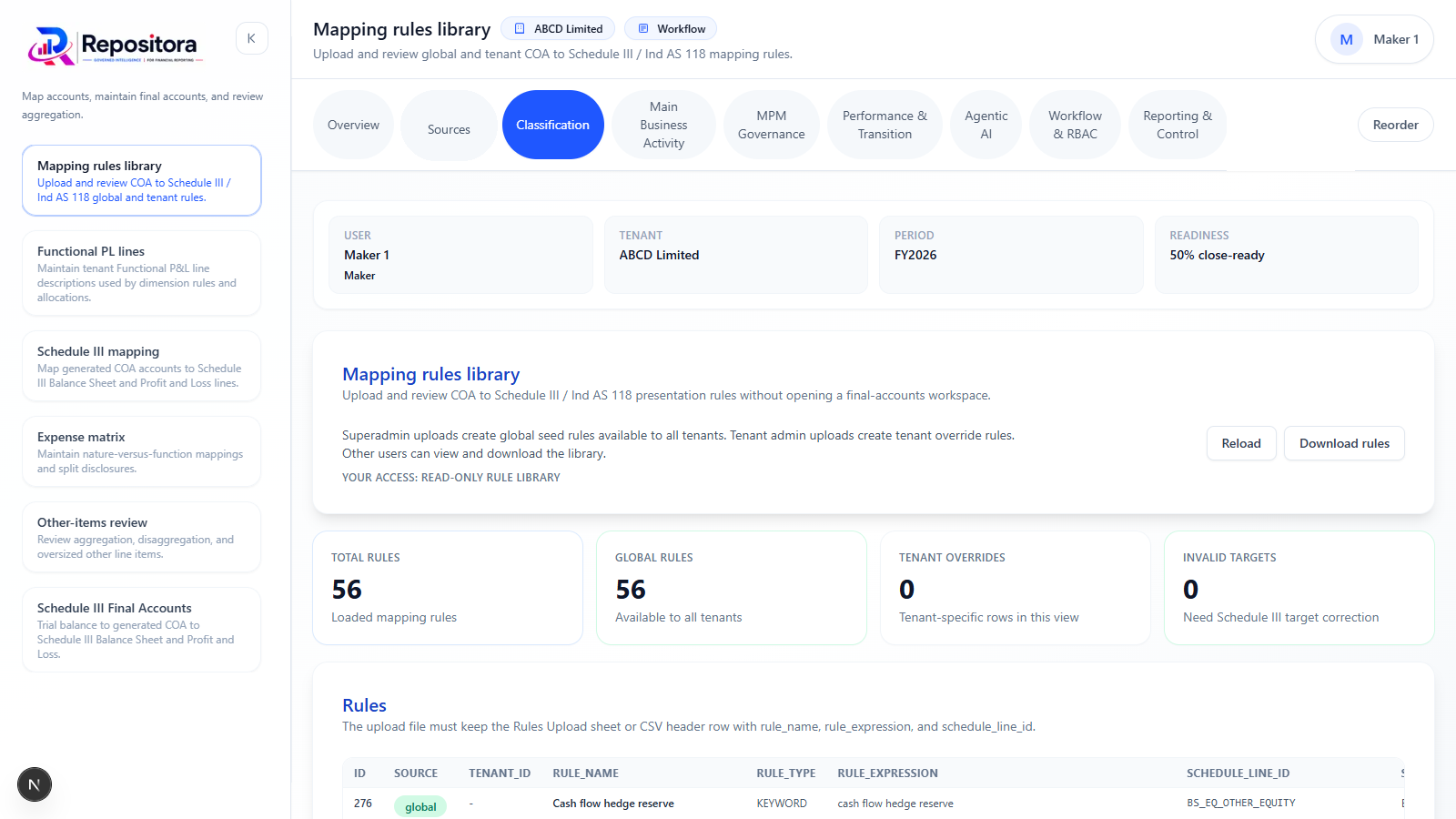
Financial reporting regulation is often implemented through documents: standards, circulars, checklists, accounting manuals and specimen financial statements. The reporting process then depends on individuals interpreting those documents and translating them into spreadsheet columns, note templates and review instructions. This approach can work for a stable environment, but it becomes fragile when multiple authorities, effective dates and reporting bases interact. A group may need current notified Ind AS financial statements, Schedule III Division II presentation, a proposed Ind AS 118 transition view, IFRS 18 reporting for an overseas parent and listed-company disclosures governed by separately amended SEBI requirements.
A regulatory rule pack converts this complexity into a controlled content layer. Each requirement is stored as a versioned object with its source authority, standard or regulation, paragraph reference, effective date, applicability, trigger conditions, required data, related statement line or note, validation logic, exemptions and guidance. The reporting output is then produced by combining the relevant accounting-standard version, jurisdictional format, reporting period, company profile, balances, transactions and user responses.
This is more than a digital checklist. A well-designed rule pack can determine that a disclosure is mandatory, conditionally applicable, possible pending a user response, not applicable, completed, incomplete or overridden with approval. It can open the relevant note, request missing data, run a deterministic validation and retain evidence of the conclusion. For Repositora, the rule-pack architecture is central to the product's differentiation: compliance and disclosure intelligence connected directly to the financial statement preparation workflow.
IFRS 18 was issued by the International Accounting Standards Board in April 2024 and is effective for annual reporting periods beginning on or after 1 January 2027, with earlier application permitted. It replaces IAS 1 and introduces defined profit-or-loss categories and subtotals, disclosures about management-defined performance measures and enhanced aggregation and disaggregation requirements. The international effective date is therefore known and can be represented as a published rule pack.
The Indian position requires more caution. ICAI issued an exposure draft of Ind AS 118 in January 2025, proposing an effective date for annual reporting periods beginning on or after 1 April 2027. Official ICAI material in 2026 continued to refer to Ind AS 118 as an upcoming standard, and the exposure draft itself should not be treated as a notified statutory requirement. Until the Ministry of Corporate Affairs issues the final standard and any consequential Schedule III changes, current notified Ind AS and proposed Ind AS 118 should remain separate content packs.
This distinction protects both compliance and product credibility. A software platform should not hard-code proposed requirements into the mandatory Indian statutory mode. It should allow users to generate a transition or readiness view, clearly display the rule pack used and update the pack when the final notification is issued. If the final Indian standard differs from the exposure draft, the change must be visible, versioned and reviewable rather than silently incorporated into a template.
Schedule III adds another layer. Its presentation and disclosure requirements are additional to Ind AS requirements, and the applicable division depends on the type of company. Listed-company obligations and regulator-specific formats may change on a different timetable. The correct architecture therefore separates accounting-standard logic, jurisdictional-format logic and entity-applicability logic instead of embedding all requirements in one large template.
The requirement object is the smallest governable unit of regulatory content. It should have a stable requirement ID and identify the source authority, standard or regulation, paragraph or statutory reference and a licensed summary or controlled internal interpretation. Effective-from and effective-to dates allow the system to determine which version applies to a reporting period. A superseded requirement remains available for historical reproduction but is not presented as current.
Applicability attributes should include entity type, listed status, industry, standalone or consolidated reporting, jurisdiction, Schedule III division and reporting period. Trigger conditions may depend on balances, transactions or questionnaire responses. A requirement for related-party disclosure, for example, may be generally applicable but require additional schedules when transactions or outstanding balances exist. A debt covenant disclosure may be triggered by borrowings and covenant breaches. A proposed Ind AS 118 specified-expense disclosure is relevant when operating expenses are presented by function.
The object should also define execution. It identifies the relevant statement line, note template, required data fields, aggregation method, validation logic and exemption conditions. Guidance and examples help the preparer understand the requirement, but they should not replace the organisation's judgement. Content-review status-draft, technical review, legal or chartered-accountant review, approved, published and superseded-ensures that only authorised content drives production reporting.
Client-specific conclusions must be stored separately from global content. A customer may decide that a particular requirement is not applicable because of its facts, or may adopt an accounting-policy interpretation reviewed by its advisers. That conclusion should reference the global requirement but should not alter the underlying rule for other tenants. This separation is critical in a multi-tenant platform.
The first layer is the accounting-standard pack. For Indian statutory reporting, this includes current notified Ind AS. A separate proposed Ind AS 118 pack supports readiness and transition analysis. An IFRS 18 pack supports entities reporting directly under IFRS or groups that need an international view. Each pack includes classification, presentation, disclosure and consequential amendment logic appropriate to that basis.
The second layer is the jurisdictional-format pack. Schedule III Division II provides the primary format for companies applying Ind AS, while other divisions or industry-specific formats can be added separately. This layer controls statement ordering, minimum line items, note cross-references, comparative presentation, rounding and jurisdictional disclosures. It should not duplicate the accounting-standard pack; it should supplement and format it.
The third layer is the entity-applicability pack. It uses company and group profiles, listed status, industry, material balances, transactions and questionnaire responses to determine which requirements are relevant. This layer can incorporate CSR, MSME, related-party, promoter-shareholding and other company-specific triggers. For groups, it also distinguishes standalone and consolidated applicability and identifies requirements that apply only when subsidiaries, associates, joint ventures, non-controlling interests or business combinations exist.
The combined result can be expressed as a simple formula: accounting-standard version multiplied by jurisdictional-format version multiplied by reporting period, company profile and relevant facts. The formula is conceptually simple, but it requires disciplined content design. If the same rule is copied into multiple templates, later changes become inconsistent. Stable requirement IDs and reusable reporting concepts reduce that risk.
A rule pack becomes useful when it drives the reporting workflow. A mandatory disclosure should create a task for the relevant owner, open the correct note template and identify required data. A conditional requirement should ask the user a structured question and retain the answer, rationale and reviewer approval. A balance-triggered requirement should be recalculated when the underlying balance changes.
For example, if a material amount is mapped to "other operating expenses," an aggregation and disaggregation rule may flag the line for review. The system should not decide materiality or automatically split the amount. It should explain the trigger, show the components and ask the preparer to conclude whether additional face or note detail is needed. The conclusion and approval become part of the evidence.
Similarly, an MPM rule should not infer that every management measure is an MPM. It should inventory subtotals of income and expenses used in public communications, test the definition, identify exclusions, and require a documented conclusion. Where a measure qualifies, the system should open the MPM register and require the formula, public communication, comparable specified subtotal, reconciliation, tax effects, NCI effects, explanation and approval.
The rule pack should also run validations. A statement line requiring a note reference can be checked for a valid link. A structured note can be tested against the related face line. A required comparative can be checked for completeness. A mandatory disclosure cannot be considered complete if a placeholder remains or an applicability override lacks approval. These are deterministic controls, not AI judgements.
Every generated report should display or record the rule-pack version used. This allows a reviewer to understand why a requirement appeared and enables the final pack to be reproduced later. The report snapshot should also retain the data snapshot, template version, calculation-engine version, generation time, user and file hash. An approved final pack is immutable; a subsequent regulatory or data change creates a new version.
Versioning is especially important around transition. An organisation may prepare a proposed Ind AS 118 impact assessment in one quarter and update it when the final standard is notified. The system should preserve the earlier analysis, show the differences between the exposure-draft and final rule packs, and identify affected classifications, notes and validation rules. This avoids rewriting history and gives management a clear basis for evaluating implementation changes.
Content administrators need a formal publishing workflow. Draft changes are prepared with source references and change explanations. Technical reviewers assess accounting accuracy, and legal or chartered-accountant reviewers confirm the Indian statutory interpretation where appropriate. Only approved content is published to customers. Published content should not be directly editable by client users; client-specific interpretations should be attached as separate conclusions.
Emergency changes also need governance. A regulator may issue a late amendment or clarification close to the reporting date. The platform should support an accelerated review path without bypassing version control. The change record should identify who approved the update, which reporting periods and customers are affected, and whether previously generated reports require regeneration.
For standalone reporting, the requirements repository can drive a company profile, disclosure checklist, note templates and basic validations for an Ind AS company using Schedule III Division II. The system can show required, possible, not applicable, completed and incomplete statuses, link each requirement to the relevant explanation and retain reasons for non-applicability.
Across multiple entities and reporting modes, Repositora makes the repository executable. Requirements can distinguish entity and group applicability, aggregate entity responses, identify group-only conclusions and support current Ind AS, proposed Ind AS 118 and IFRS 18 views. The roll-forward compares rule-pack versions, while the report snapshot records the exact content used. This turns regulatory change into an operational workflow rather than a separate technical memo.
The architecture also supports later expansion. Division III for NBFCs, SEBI reporting, banking and insurance formats, BRSR or sustainability packs can be maintained as independently versioned content. They should not be embedded in core statement logic because their amendment cycles and applicability differ. The product can therefore grow without turning its templates into an unmaintainable collection of conditional formulas.
Assume an Indian group currently prepares Schedule III Division II financial statements under notified Ind AS and also reports IFRS information to an overseas shareholder. Repositora has three active packs: current Ind AS, Schedule III Division II and IFRS 18 transition. The group's annual report is generated under the current Indian packs, while the IFRS 18 pack produces a parallel profit-or-loss statement and MPM analysis.
When the final Ind AS 118 notification is issued, the regulatory team creates a new draft pack. The system compares it with the exposure-draft transition pack and identifies changes to effective date, wording, category logic, disclosure fields or consequential amendments. Technical reviewers approve the differences, and the pack is published with a future effective date. When the group opens the relevant reporting period, the roll-forward impact report lists the affected accounts, notes, policies and validations.
The group does not need to rebuild its financial statements. Its reporting concepts and structured facts remain stable. The new pack changes how those facts are classified, presented and disclosed. Preparers review exceptions, disclosure owners complete new fields, and reviewers approve the updated conclusions. The final report records the notified Ind AS 118 pack and the applicable Schedule III pack.
A regulatory content governance committee should include technical accounting, statutory reporting, product, quality assurance and, where appropriate, legal or external professional input. The committee should approve source hierarchies, interpretation policies, content-review standards and release procedures. It should also define how quickly new requirements are assessed and how customers are notified.
Quality metrics should include requirements with missing source references, rules without validation tests, published changes lacking reviewer approval, client overrides without reasons, unresolved mandatory requirements at report generation, and reports produced using superseded packs. Another useful measure is the time from authoritative publication to approved content availability. Speed matters, but accuracy and traceability matter more.
Testing should include positive, negative and boundary cases. A rule should be tested where it applies, where it does not apply and where a user response is required. Materiality-sensitive flags should be tested at different thresholds. Historical reports should be regenerated from stored snapshots to confirm that later content changes do not alter prior approved outputs.
Versioned regulatory rule packs provide the missing connection between authoritative requirements and the daily work of financial reporting teams. They make effective dates visible, separate current and proposed bases, link requirements to data and notes, and preserve the evidence supporting applicability conclusions. This is essential in India, where Ind AS, Schedule III and regulator-specific requirements interact and do not necessarily change at the same time.
For IFRS 18 and proposed Ind AS 118, the rule-pack approach allows organisations to prepare early without misrepresenting the statutory position. Current Indian reporting remains governed by notified requirements, while transition analysis can proceed in a separate, clearly labelled environment. When the final rules change, the system identifies the impact and creates work. That is the difference between storing regulatory content and operating a regulatory reporting platform.
Official materials checked on 25 June 2026: IFRS Foundation - IFRS 18; issued IFRS 18 text; IFRIC Update - March 2026; ICAI Accounting Standards Board.
This article is educational and does not replace applicable standards, final MCA notifications, professional advice or entity-specific judgment. Product capabilities should be verified against the approved release scope before publication.
Explore how Repositora can connect entity submissions, group reporting, statutory notes, source lineage and Ind AS 118 transition readiness across standalone, group and transition reporting. Visit repositora.com