Repositora AI - Ind AS 118 / IFRS 18
Ind AS 118 readiness

Turn the new presentation standard into a clear implementation plan

IFRS 18 and Ind AS 118 change how performance is structured, labelled, reconciled, and explained. Use this hub to translate the requirements into practical workstreams for finance, reporting, systems, and governance teams.

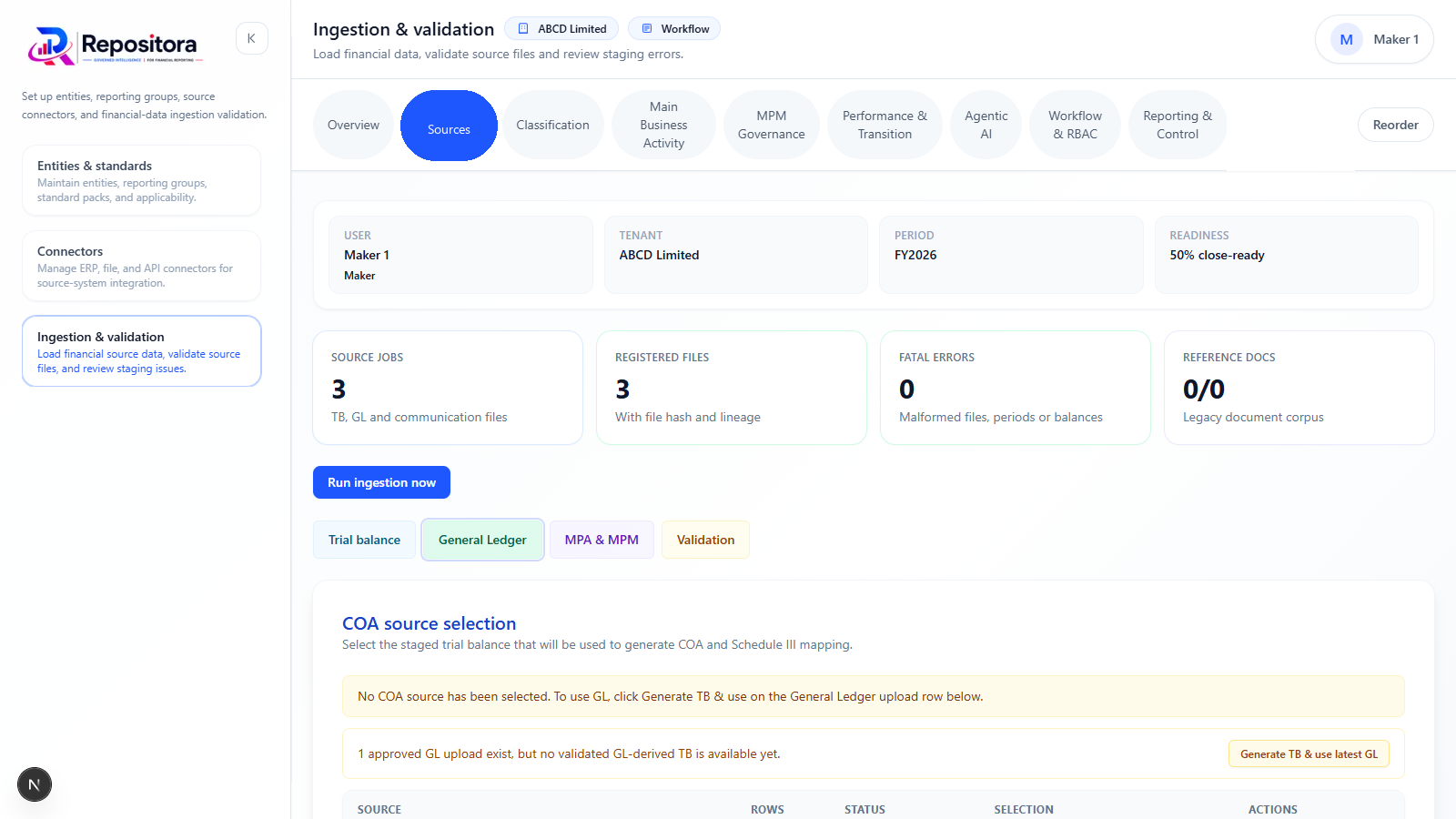
Data ingestion and validation workflow
P&L classification

Assess recurring, investing, financing, tax, and discontinued operation items before redesigning statement formats and mapping rules.

View
MPM controls

Identify management-defined performance measures, reconcile them to IFRS or Ind AS subtotals, and document why management uses them.

View
Transition evidence

Plan comparative-period restatements, audit trails, policy papers, system changes, and board-level reporting updates early.

View
What changes

The new standard changes the story told by the same numbers.

IFRS 18 and Ind AS 118 do not rewrite recognition and measurement. They change presentation discipline: where performance appears, how subtotals are defined, how adjusted measures are explained, and how information is grouped across statements and notes.

New P&L architecture

Income and expenses need a defined category

The statement of profit and loss moves from a flexible format to a clearer structure built around operating, investing, financing, income tax, and discontinued operation categories.

Required subtotals

Operating profit becomes a required anchor

Teams need to explain operating profit or loss and profit or loss before financing and income taxes in a way that users can compare across periods and entities.

Useful summaries

Primary statements and notes have distinct jobs

The face of the statements should give a useful structured summary. The notes should carry the material detail, explanations, and reconciliations behind those line items.

Better labelling

Vague line items will be harder to defend

Aggregation and disaggregation decisions need stronger judgement. Labels such as other expenses or miscellaneous income should be challenged before they reach audit review.

Readiness model

Move from technical reading to an implementation rhythm.

The hardest part is not knowing that categories and MPM disclosures exist. It is making them repeatable inside close, consolidation, review, board reporting, and external communication processes.

01

Current-state diagnostic

Review the latest annual report, interim reporting packs, management accounts, investor decks, loan covenant calculations, and adjusted performance measures.

02

Classification mapping

Create a transaction and account-level map for operating, investing, financing, tax, and discontinued operation categories, including judgement areas and exceptions.

03

MPM governance

Inventory every public adjusted measure, define ownership, prepare reconciliations, and decide which measures meet the disclosure definition.

04

Systems and controls

Update consolidation templates, chart-of-account tags, reporting calendars, preparer checklists, reviewer controls, and audit evidence files.

Judgement areas

The transition lives in the judgement calls.

A credible project record should show how each major classification, subtotal, label, and MPM decision was reached. That evidence is useful for management, auditors, boards, and users of the financial statements.

Discuss the diagnostic
Whether operating expenses are most useful by nature, by function, or through a mixed presentation.
How associates, joint ventures, treasury income, finance costs, and foreign exchange effects should be classified.
Which adjusted profit measures are management-defined performance measures and how they reconcile to required subtotals.
How comparative periods, interim reporting, and board reporting packs should be restated or bridged.
Which line items are too aggregated, too vague, or better placed in notes rather than on the face of the statement.
Transition timeline

Start before the first comparative table is due.

The visible change may be a new statement layout, but the invisible work is earlier: data tagging, policy papers, reconciliations, review controls, and communication scripts.

Now

Build the impact view

Identify affected line items, measures, teams, source systems, and control owners. Use this as the basis for audit and board conversations.

Design

Agree policies and formats

Draft the new P&L format, note structure, MPM note, labelling approach, and comparative-period bridge before systems work begins.

Dry run

Produce a parallel close

Run one reporting period under the proposed format, test reconciliations, and capture reviewer comments before external reporting pressure increases.

Adopt

Embed reporting discipline

Move the final model into close calendars, disclosure checklists, investor messaging, audit files, and ongoing governance forums.

Control checklist

Evidence should be designed, not assembled at year end.

The teams that move fastest will treat Ind AS 118 as a reporting infrastructure project. The right controls make the revised presentation easier to prepare, review, audit, and explain.

A single owner for P&L classification judgements

Documented rationale for each MPM and related reconciliation

Reviewer sign-off over aggregation, labels, and note location

Audit trail from trial balance to revised statement line items

Clear communication plan for analysts, lenders, and directors

Frequently asked

Questions finance teams should settle early.

Does IFRS 18 or Ind AS 118 change recognition and measurement?

No. The main change is presentation and disclosure. The same underlying accounting numbers may be reorganized into new categories, subtotals, notes, and reconciliations.

Why should finance teams start before the effective date?

The transition can affect chart-of-account mappings, consolidation packages, alternative performance measure governance, comparative information, audit evidence, and investor communication.

What is the most common first step?

Start with a diagnostic of current statements, board packs, investor presentations, and non-GAAP or adjusted measures. That reveals which classifications, labels, and reconciliations need design work.

Next step

Build a reporting change plan before the calendar forces one.

Use a short diagnostic to identify high-risk classifications, MPMs, system dependencies, and disclosure gaps. The output should be a board-ready roadmap, not just a technical memo.

Repositora AI - Ind AS 118 / IFRS 18