IFRS 18, Presentation and Disclosure in Financial Statements, changes the way companies communicate financial performance. It does not change the recognition and measurement of profit in the way a revenue, lease, or financial instrument standard might. Its focus is presentation, structure, aggregation, subtotals, and the discipline around performance measures used in public communication.
In India, the proposed Ind AS 118 has been formulated on the basis of IFRS 18. As of the date of this draft, ICAI has issued the exposure draft and NFRA has recommended Ind AS 118 to the Central Government for consideration of notification, with application recommended for annual reporting periods beginning on or after 01-04-2027. Companies should therefore treat the transition as a systems, process, and control preparation exercise, not only a year-end disclosure exercise.
IFRS 18 requires a clearer structure in the statement of profit or loss. The Standard introduces defined categories for income and expenses, requires new defined subtotals such as operating profit or loss and profit before financing and income taxes, and adds principles for aggregation and disaggregation. It also brings management-defined performance measures, or MPMs, into the notes to the financial statements when specified conditions are met.
These outcomes sound like presentation matters. In practice, they depend heavily on source data.
If the chart of accounts is too broad, if cost centre and profit centre fields are incomplete, if GL lines cannot be traced to trial balance balances, or if reporting teams cannot explain why a line moved into a category, the final statement may still add up, but it will not be robust. The real preparation question is therefore:
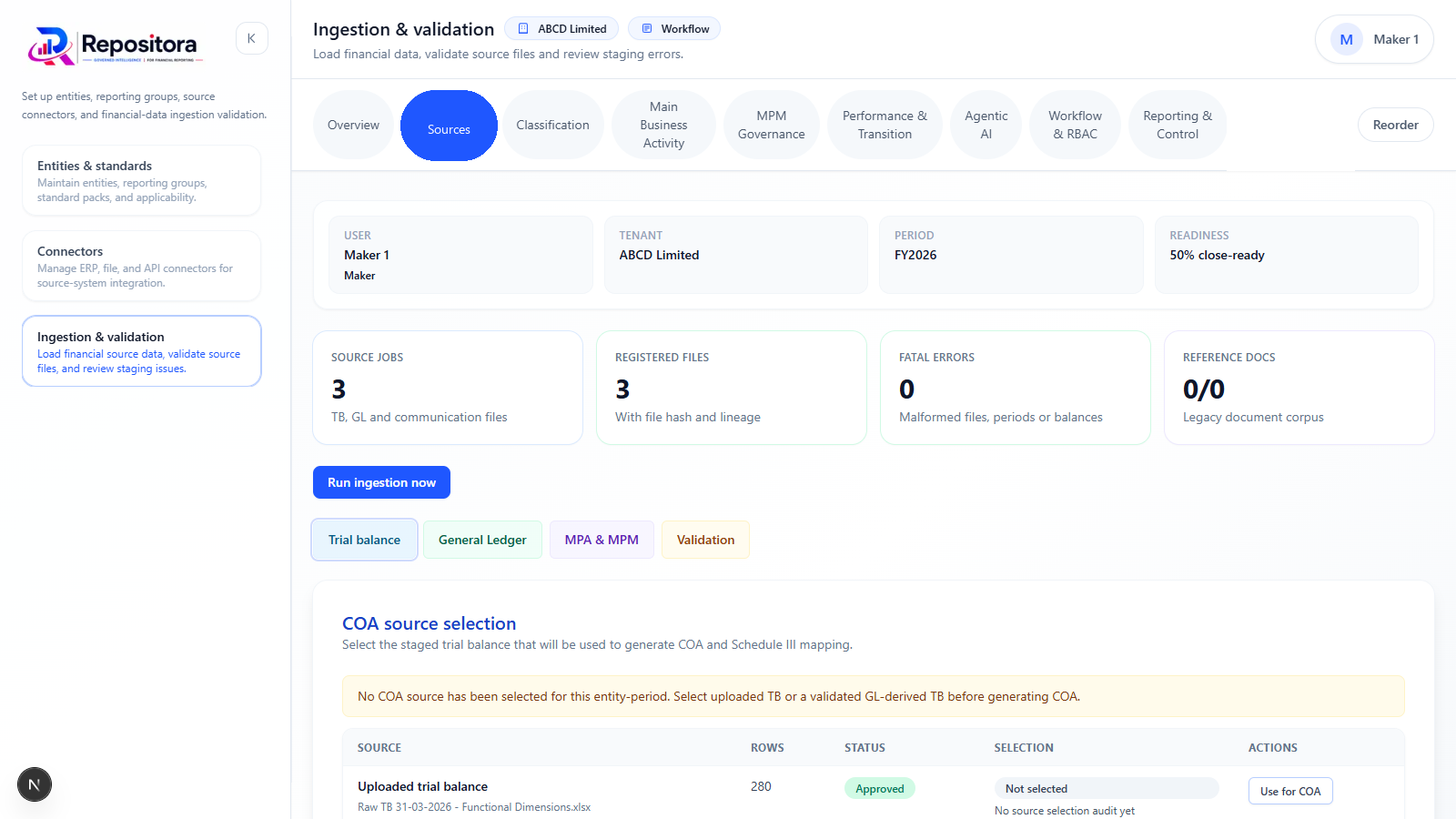
Which source should drive the reporting model for this entity-period?
For some companies, an uploaded trial balance is enough. For others, the trial balance may need to be derived from a detailed general ledger first, especially where the same account head carries different cost centres, profit centres, segments, or nature tags.
Many finance teams will have both files available: a trial balance exported from the ERP and a general ledger dump with transaction-level details. Both are useful, but they do not serve the same purpose.
An uploaded trial balance is compact and familiar. It is usually the fastest route when balances are already enriched with the dimensions needed for Schedule III and Ind AS 118 style mapping. It works well when each row already carries the information needed to classify the account, validate the reporting line, and support current and comparative presentation.
A GL-derived trial balance is more powerful when the trial balance by itself is too flat. If one expense account includes multiple functions, locations, customer groups, projects, or business units, the GL may be the only place where those dimensions can be preserved. In that case, the system should first aggregate the GL into a dimensional trial balance, and only then proceed to COA generation, Schedule III mapping, functional expense analysis, and Ind AS 118 reporting.
The important point is not that one source is always superior. The important point is that the active source should be selected, visible, auditable, and repeatable. If both TB and GL coexist, the system should not silently prefer one. The user should be able to say: use the uploaded TB, or derive the TB from GL and use that as the basis for COA and reporting.
This is a small workflow choice with a large control consequence.
Under an Ind AS 118 readiness model, the trial balance is no longer just account code, account name, debit, and credit. It becomes the bridge between source accounting and structured performance reporting.
A useful dimensional trial balance can carry:
- account code and account description;
- current and previous year balances;
- cost centre and profit centre;
- segment, product, project, plant, or business unit identifiers;
- nature of expense or income;
- source file and upload lineage;
- maker-checker status and approval timestamp.
This level of enrichment helps reporting teams answer questions that are difficult to answer from a flat TB:
- Why is this expense in cost of goods sold rather than administrative expenses?
- Which accounts form operating profit?
- Are financing and investing items consistently identified?
- Which PL rows need functional allocation?
- Which source lines support an MPM adjustment?
A platform such as Repositora can support this by keeping source selection explicit and then carrying the selected basis into downstream classification, Schedule III mapping, expense matrix allocation, MPM governance, and report generation.
Categories, Subtotals, And The Main Business Activity Lens
IFRS 18 requires income and expenses to be classified into categories such as operating, investing, financing, income taxes, and discontinued operations. The classification may differ depending on the entity's main business activities. For example, an entity that provides financing to customers as a main business activity may classify some income and expenses differently from a manufacturing entity.
This means the reporting engine cannot be only a static mapping table. It needs a structured assessment of the entity's main business activity, with the ability to apply that conclusion consistently across accounts and periods.
For Indian companies, this also needs to live alongside Schedule III presentation. Schedule III remains a familiar statutory format, while Ind AS 118 introduces a more structured performance presentation model. A practical system should therefore support both:
- Schedule III balance sheet and profit and loss outputs;
- Ind AS 118 style profit and loss by nature and by function;
- financing and investing main business activity views where relevant;
- clear reconciliation between mapping rules and generated report rows.
The goal is not to replace accounting judgement. The goal is to make judgement visible, versioned, and consistently applied.
One of the important practical areas is operating expense presentation. IFRS 18 strengthens the discipline around presenting expenses by nature, by function, or using a mixed presentation when that provides the most useful structured summary. The IFRS Foundation has also discussed specified expense-by-nature disclosures where expenses are presented by function.
For finance teams, this creates a familiar but demanding task: allocating expenses meaningfully without turning the process into arbitrary spreadsheet engineering.
Consider a power and utilities account. Some of it may relate to manufacturing operations, some to selling locations, and some to corporate administration. If the trial balance has only one account-level balance, the allocation will need a defensible rule. If dimensions exist in the GL, the allocation can be more evidence-based. If dimensions are incomplete, the exception should be visible before the report is final.
This is why an expense matrix should ideally show current year and previous year rows separately, support percentage and actual amount allocation, and preserve the basis of the allocation. It is also why totals should be checked for completeness, rather than assumed.
Management-defined performance measures are one of the most visible changes introduced by IFRS 18. MPMs are not every metric used by management. They are subtotals of income and expenses that meet the Standard's definition, including use in public communications to communicate management's view of an aspect of financial performance.
Where an MPM exists, the reporting process should not stop at calculating the number. It should capture:
- why management uses the measure;
- the closest IFRS or Ind AS subtotal;
- each reconciling adjustment;
- current and comparative amounts;
- tax and non-controlling interest effects where applicable;
- changes from the prior period;
- approval and snapshot history.
This turns an MPM from a slide-deck metric into a controlled disclosure. In practical terms, a template can be a good starting point, but each company should save its own version so that the standard template remains intact and the company-specific policy, adjustments, and naming are preserved.
Under IFRS 18 and the proposed Ind AS 118, the visible report is only the last mile. The stronger question is whether the report can be regenerated and explained.
A controlled close process should be able to show:
- who uploaded the TB or GL;
- who approved the upload;
- whether the active COA source is uploaded TB or GL-derived TB;
- when the source was selected;
- which mapping rules were applied;
- what exceptions remain unresolved;
- which MPMs were approved and which are draft;
- when the final report pack was locked.
This is where maker-checker workflows and audit trails matter. They are not administrative decoration. They are evidence that the reporting output came from approved inputs, approved mappings, approved classifications, and approved disclosures.
Finance teams preparing for IFRS 18 or Ind AS 118 can begin with a focused diagnostic:
- Identify whether the current reporting model should start from uploaded TB, GL-derived TB, or both depending on entity and period.
- Check whether current and previous year data contain the same dimensions.
- Map accounts to Schedule III and Ind AS 118 presentation lines with rule ownership and approval status.
- Assess main business activities before finalising operating, investing, and financing categories.
- Build a functional expense allocation basis that supports both percentage and actual amount rules.
- Inventory all public performance measures and test whether they are MPMs.
- Create company-specific MPM definitions from standard templates rather than editing the template itself.
- Maintain maker-checker evidence for uploads, mappings, source selection, approvals, and report locks.
- Re-run reports from the selected source and compare current year and previous year presentation.
- Monitor final MCA, NFRA, ICAI, and SEBI updates before statutory adoption.
IFRS 18 and Ind AS 118 are often described as presentation standards. That is technically correct, but it understates the operational change. Better presentation requires better source lineage, cleaner dimensions, clearer classification logic, disciplined MPM governance, and stronger auditability.
The companies that prepare early will not simply produce a different profit and loss format. They will build a more explainable reporting process.
- IFRS Foundation, "IFRS 18 Presentation and Disclosure in Financial Statements", effective for annual reporting periods beginning on or after 01-01-2027: https://www.ifrs.org/issued-standards/list-of-standards/ifrs-18-presentation-and-disclosure-in-financial-statements/
- ICAI, "Exposure Draft of Ind AS 118, Presentation and Disclosure in Financial Statements", issued 06-01-2025 and proposing application from annual reporting periods beginning on or after 01-04-2027: https://www.icai.org/post/asb-ed-indas118-pdfs
- NFRA, record note of the 22nd meeting held on 22-12-2025, recommending Ind AS 118 to the Central Government and noting possible Schedule III and SEBI updates: https://cdnbbsr.s3waas.gov.in/s3e2ad76f2326fbc6b56a45a56c59fafdb/uploads/2026/01/2026011620325560.pdf
- IFRS Foundation, agenda decision and supporting material on the scope of expenses by nature disclosures under IFRS 18: https://www.ifrs.org/projects/completed-projects/2026/scope-requirement-disclose-expenses-nature-ifrs-18/tad-and-cls/