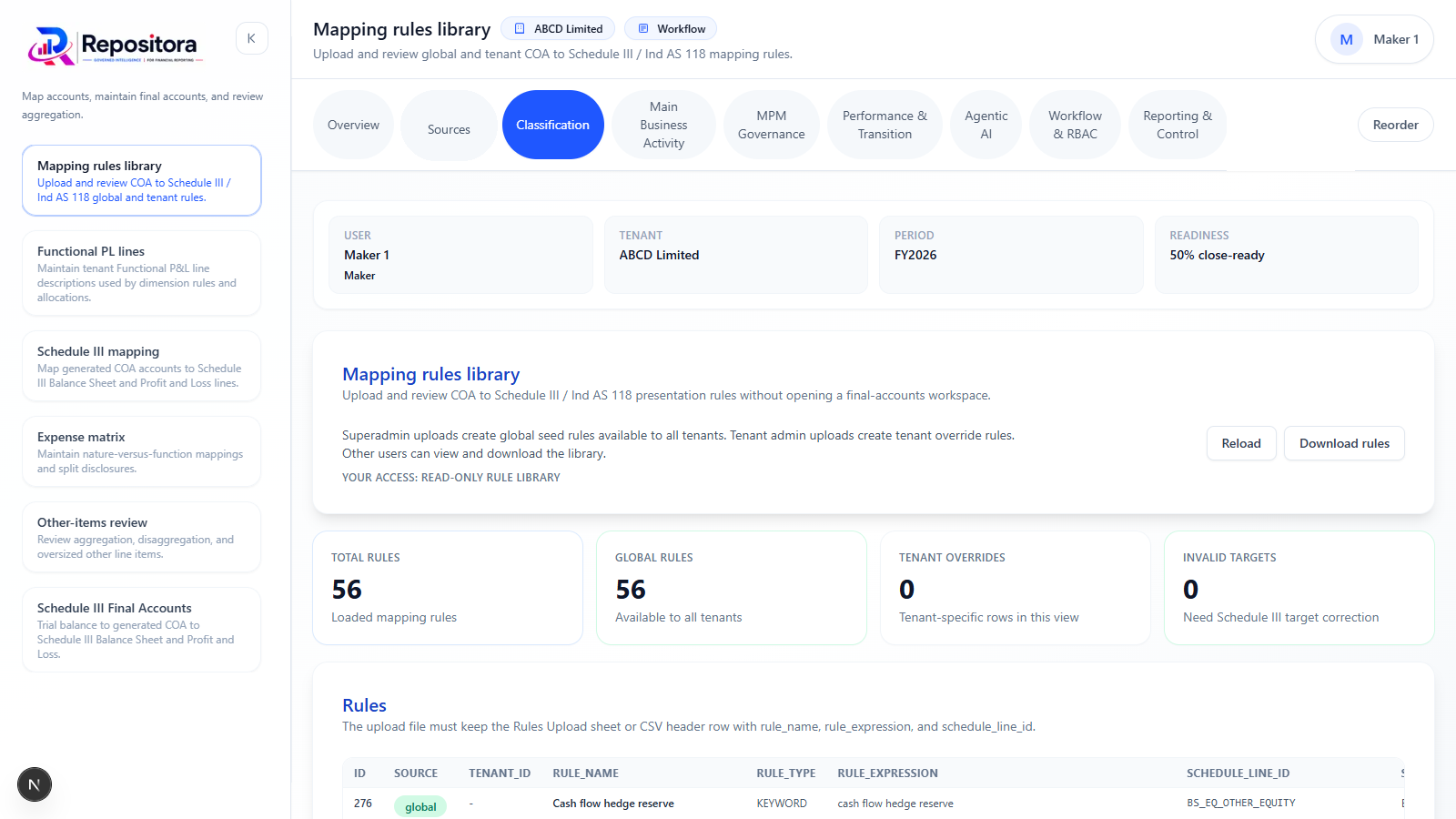
Account mapping is often described as a technical step between the trial balance and the financial statements. In reality, it is one of the most consequential financial reporting judgements. A mapping determines where an amount appears, which note schedules it affects, how it is aggregated across entities and, under IFRS 18 or proposed Ind AS 118, which profit-or-loss category contributes to defined subtotals. An incorrect mapping can leave the trial balance balanced while the financial statements are materially misleading.
A group environment needs two mapping levels. The first connects each local account to a group account. The second connects the group account to a stable reporting concept used in statements, notes, validations and digital tags. This design allows entities with different charts of accounts to contribute to a common group model without forcing every entity to adopt the same ledger structure.
The distinction also supports governance. Local mapping changes can be reviewed in the context of the group account, while statutory presentation changes can be made at the reporting-concept level without remapping every source account. Repositora should allow entities to inherit group mappings, apply controlled local overrides and retain a complete history of original and revised classifications.
Many spreadsheets map a source account directly to a row number in a financial statement. That approach is easy to understand initially, but it binds data to a specific layout. When Schedule III ordering changes, a note is renumbered or an IFRS 18 presentation is introduced, the mapping must be rebuilt. The same account may also need to contribute to multiple outputs, such as a face line, ageing note, related-party disclosure and MPM reconciliation.
A canonical reporting concept is more stable. For example, a local account for domestic trade receivables might map to a group account for trade receivables and then to a concept such as current trade receivables. That concept can feed the balance sheet, receivable note, ageing schedule, credit-risk disclosure and related-party analysis. Presentation templates decide where the concept appears; the mapping does not depend on a cell address.
Direct mapping also obscures differences between local interpretation and group presentation. If an entity uses a broad "other income" account, the group needs to know the economic components before assigning IFRS 18 categories. Mapping the entire account to one report row may hide mixed operating and investing income. A two-level model surfaces the need for account split, allocation or adjustment.
The group account is a common semantic layer. It should describe the economic nature and business purpose of balances in a way that can be applied across entities. It is not necessarily the group general ledger account; it may be a reporting taxonomy designed for statutory and consolidation purposes.
Entities should inherit standard mappings where local accounts are aligned. Inheritance reduces work and improves consistency. The entity can still request an override where local usage differs. An override should record the original mapping, revised mapping, reason, effective period, user and reviewer approval. The system should show whether the change affects current and comparative periods.
New accounts should enter a controlled workflow. The entity proposes a mapping, the mapping owner reviews it, and material accounts may require group approval before the package can be accepted. Auto-suggestions can help identify likely mappings based on descriptions and prior patterns, but they should remain suggestions. The approved mapping is a financial reporting conclusion.
Local accounts may need to split across group accounts. A shared-cost account may contain employee benefits, depreciation and other expenses, or a single interest account may include bank borrowing interest and unwinding of provisions. The split should be performed through a controlled allocation or adjustment with a documented basis. The system should not hide a one-to-many mapping inside an opaque formula.
The reporting concept connects economic data to the statutory model. It identifies statement classification, current or non-current status, note links, disclosure dimensions, sign convention, calculation role and potential taxonomy tag. The concept should remain stable even when the report layout changes.
For profit-or-loss concepts, the model should store IFRS 18 and proposed Ind AS 118 category assignment: operating, investing, financing, income taxes or discontinued operations. It should also store the relevant rule, main-business-activity impact, group override, rationale, preparer, reviewer and rule-pack version. The category is not merely a label; it drives operating profit and profit before financing and income taxes.
A concept may have multiple presentation views. Current Ind AS and Schedule III may use one ordering and terminology, while an IFRS 18 view applies defined categories and subtotals. The underlying amount remains the same unless a transition adjustment is recorded. This is how dual-basis reporting can be generated from one fact model.
The concept layer should also support notes. A borrowing concept may connect to current and non-current presentation, debt maturity, covenant and finance-cost schedules. A revenue concept may carry segment, geography or product dimensions. Mapping should therefore be designed with disclosure requirements in mind, not only face statements.
A mapping dashboard should show percentage mapped and, more importantly, the value of unmapped balances. A 99 percent mapping rate can still be unacceptable if the unmapped one percent is material. The dashboard should identify material unmapped accounts, new accounts, accounts whose mapping changed and accounts mapped to broad "other" concepts.
Cross-entity analytics are especially valuable. The system can identify similar account descriptions mapped differently across entities, the same group account used for inconsistent local purposes and entities using local overrides more frequently than peers. These are indicators for review, not proof of error.
For IFRS 18 transition, the dashboard should show unclassified income and expense concepts, accounts containing mixed categories, entity classifications inconsistent with the group view and classification changes between periods. It should also identify items affected by main-business-activity conclusions.
Mapping analytics should integrate with materiality. Low-value dormant accounts may be accepted with simplified treatment, while material or unusual accounts require explanation. Thresholds should be configurable by entity and group, and reviewers should be able to override a flag with a reason.
Accounts mapped to "other" deserve focused attention because they can obscure material information. IFRS 18 and proposed Ind AS 118 strengthen aggregation and disaggregation principles and restrict uninformative use of "other." The mapping process should show the underlying account composition and ask whether a more informative concept is available.
A mixed account contains components with different characteristics. For example, "finance charges" may include bank interest, lease interest, unwinding of provisions and transaction costs. Under the new profit-or-loss categories, some components may require different analysis. A single mapping may no longer be sufficient.
The solution is not automatically to create hundreds of ledger accounts. Finance can use subaccount dimensions, schedule allocations or controlled reporting adjustments. The chosen method should be repeatable and reconciled to the source. The reporting platform should retain the allocation basis and approval.
A mapping change can represent correction, business change, regulatory change or presentation refinement. The reason matters. A correction may require comparative restatement or disclosure. A regulatory change may require a transition adjustment between prior as reported and prior restated views. A business change may apply only prospectively.
The system should compare mappings between periods and show the value affected. A user should not be able to overwrite the historical mapping and thereby change a prior approved report. Historical facts remain linked to the mapping version used in the original snapshot. Restated comparatives use a separate scenario or mapping version with a documented bridge.
Material changes should require maker-checker approval. The reviewer should see the original mapping, proposed mapping, rationale, affected amounts, statement lines, notes and IFRS 18 category impact. This makes review substantive rather than procedural.
The mapped balance should reconcile to the source trial balance. The system should show source amount, local adjustments, adjusted entity amount, group mapping, reporting concept and final presentation. If an allocation splits an account, the components should sum to the source amount at full precision.
Drill-down from a statement line should show contributing reporting concepts, group accounts, entities, local accounts and import rows. This lineage makes mapping transparent. It also allows auditors to test the mapping population and select changes for review.
Rounding should occur only during presentation. Mapping and aggregation should use full precision to avoid unexplained differences. The reporting model should not use Excel cell references as its calculation engine; formulas should operate on concepts and dimensions.
For standalone reporting, Repositora establishes account-to-reporting-concept mapping for a single entity, with bulk mapping, prior-year reuse, completeness indicators and audit trail. It supports the generation of statements and related notes from stable concepts.
For group reporting, Repositora adds the local-to-group layer, group inheritance, controlled overrides and cross-entity analytics. It separates entity mappings from group presentation and supports standalone, pre-consolidated and basic aggregation modes. The same group concepts feed consolidation, notes, transition analysis and digital reporting.
The mapping design should allow profiles to be rolled forward but not blindly approved. New accounts, changed descriptions and regulatory impacts are highlighted. AI may suggest mappings based on approved patterns, but human approval remains required, especially for material items and IFRS 18 category assignments.
A diversified group has three subsidiaries with accounts named "interest income." Subsidiary A earns deposit interest incidental to operations. Subsidiary B provides financing to customers as a main business activity. Subsidiary C holds a portfolio of investments as part of treasury management. All three local accounts were historically mapped to one "other income" row.
Under the two-level model, each local account maps to an appropriate group account based on its economic source. The group accounts then map to reporting concepts with category logic. For Subsidiary B, financing income may be operating because of the main-business-activity conclusion. For the other entities, classification may differ. At the group level, the main-business-activity assessment and group override are reviewed.
The system flags the old "other income" mapping as mixed and material. The group records the rationale, approves the category assignments and generates current Ind AS and proposed Ind AS 118 views. The underlying balances do not change, but the presentation and defined subtotals do. The mapping evidence explains why.
Begin with a reporting taxonomy, not with the source charts. Define stable group accounts and reporting concepts based on economic meaning, statement and note needs, consolidation requirements and transition categories. Then map representative entities and refine the taxonomy where genuine differences exist.
Create a mapping governance policy covering ownership, approval thresholds, effective dates, overrides, allocations and comparative treatment. Train users to consider disclosure impact and category assignment, not only the nearest account name.
Useful metrics include material unmapped value, number and value of mapping changes, overrides by entity, accounts mapped to "other," mixed-category accounts, inconsistent cross-entity mappings and changes made after entity approval. The trend should show improving stability without suppressing necessary review.
Two-level mapping is the semantic foundation of controlled group reporting. It absorbs local chart differences, preserves group consistency and connects balances to statements, notes, classifications and digital tags. It also allows the reporting layout to evolve without rebuilding every source mapping.
For IFRS 18 and proposed Ind AS 118, mapping becomes an explicit part of the technical accounting process. Category assignments, main-business-activity effects and disaggregation decisions must be visible and reviewable. A well-designed mapping layer makes those judgements scalable across the group while keeping every final amount traceable to its source.
A controlled process begins with an explicit inventory of the data objects that drive two-level group account mapping. For this subject, the core objects are local accounts and local chart versions, group accounts and hierarchies, local-to-group mapping assignments, reporting concepts and attributes, group-to-concept mappings, controlled allocations and splits, mapping overrides and approvals, and mapping analytics and change histories. Each should have a business definition, source, owner, effective period, version, status and relationship to the reporting output. That metadata is what allows the team to distinguish a valid change in policy or business activity from an unexplained movement in a spreadsheet.
Evidence should be captured as part of the workflow rather than attached after the reviewer asks for it. Each mapping should identify the source account, target group account or reporting concept, effective period, preparer, reviewer and rationale where judgment is involved. A local override should preserve the inherited mapping and show the value and reports affected by the change. Every final statement or note amount should be able to display the concepts, group accounts and local accounts that contribute to it. For two-level group account mapping, the reviewer should be able to move from the reported result back through the decision, rule or mapping to the complete source population without changing systems or requesting an offline reconstruction.
A practical design workshop for two-level group account mapping should use one completed reporting period and one difficult entity or disclosure population. Bring together group reporting, entity finance, accounting policy, tax, treasury, investor relations, internal audit, external-audit liaison and technology as relevant. Reconstruct the path from source file or manual schedule to the final statement, note and approval. Mark every copied value, mixed account, offline adjustment, unversioned judgment, repeated reviewer query and late document edit. The purpose is to identify where the statutory fact or conclusion leaves the controlled model.
Test the proposed design against local accounts are mapped directly to changing statement rows and every template update requires a group-wide remapping exercise and profit-or-loss category, note and cash-flow mappings are stored in separate workbooks and drift apart. For each break, agree the accountable owner, preventive or detective control, source evidence, materiality or tolerance, reviewer, escalation route, affected reports and acceptance test. Assign source-account to canonical reporting-concept mapping to the standalone foundation and introduce a group chart and local-to-group mapping layer only after the underlying concepts and evidence are stable. The output should be a prioritised backlog with rule, data, workflow and report-design decisions-not a generic list of desired features.
Official materials checked on 25 June 2026: IFRS Foundation - IFRS 18; issued IFRS 18 text; IFRIC Update - March 2026; ICAI Accounting Standards Board.
This article is educational and does not replace applicable standards, final MCA notifications, professional advice or entity-specific judgment. Product capabilities should be verified against the approved release scope before publication.
Explore how Repositora can connect entity submissions, group reporting, statutory notes, source lineage and Ind AS 118 transition readiness across standalone, group and transition reporting. Visit repositora.com