A financial statement number is trustworthy when the organisation can explain where it came from, how it changed and who approved the change. In many reporting processes, that explanation depends on a preparer navigating a chain of workbooks: the published report links to a master schedule, the schedule links to a consolidation file, the consolidation file links to entity tabs, and the entity tabs link to uploaded trial balances. If a formula or file version changed, the chain may no longer reproduce the reported amount.
Source-to-report lineage replaces that informal chain with a structured path. A user clicking a consolidated statement line sees the entities contributing to the line, accounts within each entity, entity adjustments, consolidation and elimination journals and the source import rows. Each layer retains its own version, period, scenario, user and evidence. The final report snapshot identifies the exact data and rules used.
Lineage is not merely an audit feature. It improves preparation, review, variance analysis, issue resolution and transition work. For IFRS 18 and proposed Ind AS 118, it allows reviewers to see which source accounts contribute to operating, investing or financing categories and which adjustments change defined subtotals. It makes classification judgements explainable at scale.
The chain begins with the source import. Every accepted row retains the source file or API reference, worksheet or payload location, row number, original account, amount, dimensions and transformations. The import version identifies whether the row came from the original or revised submission.
The local account maps to a group account and then to a reporting concept. Mapping versions and overrides are recorded. If an account is split, the allocation components and basis are visible and reconcile to the source amount.
Entity statutory adjustments are stored separately from imported balances. The entity adjusted balance equals source facts plus posted entity adjustments. The group aggregation sums accepted entity adjusted balances. Consolidation and elimination journals then create the final consolidated balance.
The statement template and rule pack determine presentation. The report line draws from reporting concepts and scenarios; it does not contain the underlying accounting logic as a cell formula. Note schedules use the same concepts and additional dimensions. The report snapshot records the data, mapping, rule and template versions.
A report can balance and still contain incorrect classification, incomplete entities or unsupported adjustments. Balance checks prove arithmetic relationships, not source integrity. Lineage allows the reviewer to test the composition of a line and identify unexpected contributors.
For example, a consolidated "other operating expenses" line may include accounts from 12 entities. The total agrees to the trial balance, but one material account is an investment disposal cost that may belong in another IFRS 18 category. Drill-down shows the account and its mapping, allowing technical review.
Similarly, a note may reconcile to the face line only because a manual plug was entered. Lineage shows that the note total includes a manual fact without source evidence. The validation can flag the override even though the arithmetic agrees.
Lineage therefore supports qualitative assurance. It helps reviewers understand the nature, origin and control status of the amount rather than only its total.
A long-form fact model stores each amount with dimensions such as tenant, group, entity, period, scenario, currency, reporting concept, source account, adjustment layer and source reference. Additional dimensions may include segment, counterparty, ageing bucket or note field. Facts remain atomic enough to support drill-down and aggregation.
Scenarios should include current year, prior as reported, prior restated, transition adjustment, entity adjustment, consolidation adjustment, elimination, final consolidated, current Ind AS, proposed Ind AS 118 and IFRS 18. The same fact can participate in different views through rules, while adjustments remain separate.
Identifiers must be stable. A reporting concept should not change because a note number changes. An import row should have a durable reference. Journals and approvals should have immutable IDs. This allows the system to link objects and preserve historical reports.
Calculations should use a dependency graph or rule engine, not workbook cell addresses. The graph records which facts and rules produced a calculated subtotal. Full precision is maintained until presentation rounding.
The first level shows the reported line, current and comparative amount, variance, rule pack and status. The user can expand to reporting concepts, then to entities and accounts. Adjustment layers are displayed separately so that the reviewer can distinguish source contributions from group changes.
Each account view shows source description, mapping, original and adjusted amount, import version and relevant validation exceptions. Each journal view shows type, lines, rationale, evidence, preparer, reviewer and posting status. The user can open the exact source row or attachment subject to permissions.
For notes, drill-down should reflect the schedule dimensions. A receivable ageing total expands by entity, ageing bucket and counterparty. A PPE movement expands by asset class and movement type. A note-level adjustment is shown separately and linked to the statement journal or explanation.
The experience should avoid overwhelming users with raw data. Filters, materiality thresholds and breadcrumbs help navigation. A "back to report" path allows the reviewer to move between output and source without losing context.
Financial statements contain narrative information as well as amounts. Narrative lineage should show the template version, prior-year text, current edits, author, reviewer and related requirement. Controlled variables identify which amounts or dates were inserted automatically.
If a user manually overwrites a variable, the system should highlight the override and retain the original calculated value. This prevents a narrative from displaying a stale amount after the underlying fact changes.
Accounting policies should link to the relevant standard or rule pack and show whether the policy was carried forward, modified or reviewed because of a regulatory change. Narrative comparison can highlight additions and deletions between periods.
AI-assisted drafting can produce a suggestion from approved facts, but the suggestion, facts used, model version, edits and approval should be retained. AI output should not replace source lineage; it should add another documented layer.
Review comments should attach to the object being reviewed. A statement-line query is linked to the line and its contributing facts. A mapping query is linked to the mapping version. A journal query is linked to the journal. This makes issue history part of lineage.
When a source fact changes, the system should identify dependent objects. A revised entity trial balance may affect statement lines, note schedules, consolidation journals, MPM reconciliations and generated reports. Those items can be marked for reperformance.
Approval freezes the reviewed version. A later change creates a new version and does not erase the prior approval. The final report snapshot contains only approved or permitted objects and records unresolved exceptions, if any, based on policy.
External auditors can use read-only lineage to select samples and raise queries. Management retains posting and approval responsibility. Exported audit packs can include mapping, journal and validation reports without giving unrestricted system access.
Category assignments should be traceable from the report subtotal to the underlying concepts and accounts. The operating profit calculation is the sum of items classified in the operating category, subject to the applicable rules. A reviewer can identify accounts classified by exception or group override.
Main-business-activity conclusions should link to the questionnaire, evidence, approver and affected concepts. Where a group conclusion differs from an entity conclusion, the lineage should show the override and rationale.
MPM reconciliation items should link to financial facts and adjustments. Tax and NCI effects should have their own source or approved calculation. A user should be able to move from the MPM note to the specified subtotal and each reconciling item.
Aggregation and disaggregation review benefits from account composition. The system can show what lies behind "other" lines and whether items have shared characteristics. The judgement remains with management, but the evidence is immediately available.
The standalone reporting workflow should provide traceability from imported trial balance through mapping and adjustments to the reported statement and note. It should generate mapping, adjustment and validation reports and retain report versions.
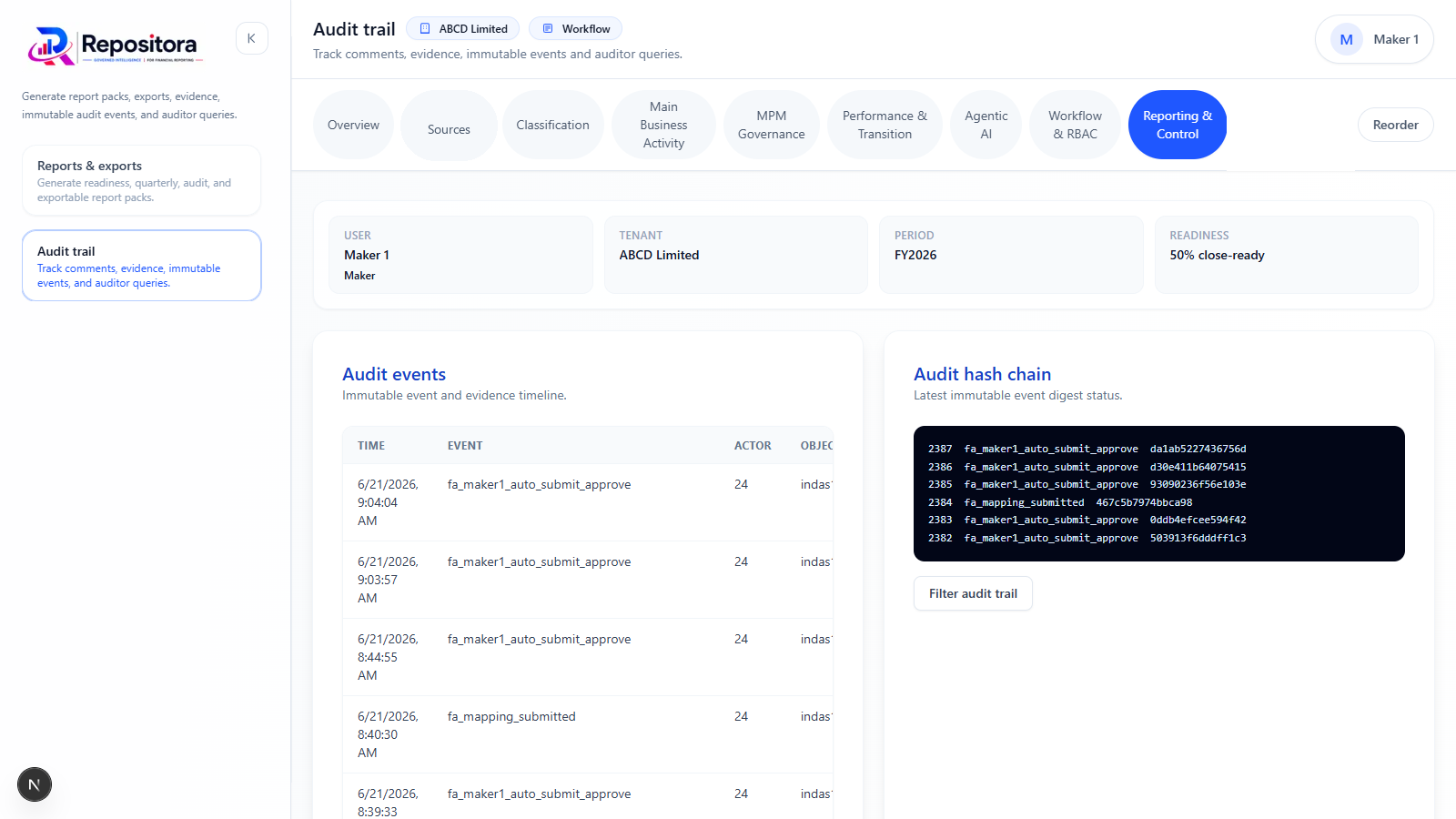
For group reporting, lineage extends across entities, local and group mappings, entity submissions, consolidation layers, note aggregation, transition scenarios and report snapshots. The design also introduces immutable audit events and entity- or section-level permissions.
Complete lineage is one of the most important product investments because it connects every other feature. Without it, more sophisticated workflows and analytics can still produce outputs that depend on hidden manual steps.
A reviewer selects consolidated operating profit and drills to a material "other operating income" line. The line contains contributions from five entities and a group reclassification journal. One entity account is a gain on disposal of an investment. The mapping dashboard shows that it was inherited from a broad local mapping and classified as operating.
The reviewer opens the source row, confirms the account description and raises a mapping issue. Technical accounting concludes that the amount belongs in the investing category. The mapping is changed with approval, the proposed Ind AS 118 view recalculates and operating profit decreases. Total profit is unchanged.
The report comparison identifies the affected subtotal and note. The final snapshot records the revised mapping, reviewer approval and source row. The audit trail explains the change without reconstructing a spreadsheet chain.
Define lineage requirements before building reports. Identify the lowest source level needed for assurance, the adjustment layers, stable identifiers and permissions. Avoid loading only aggregated totals if the organisation expects account-level drill-down.
Test lineage through realistic journeys: statement to entity, note to schedule row, journal to evidence, narrative variable to fact and final report to snapshot. Historical reproduction should be part of acceptance testing.
Useful metrics include reported lines without full source references, manual facts without evidence, mappings without approval, journal-note links missing, data changes after review and time to answer audit samples. The goal is not merely to store an audit log; it is to make the report explainable in normal use.
Source-to-report lineage is the architecture that converts a reporting application from a document generator into a controlled financial reporting system. It proves how accepted data, mappings, adjustments, rules and templates produced each amount and disclosure.
For group reporting and Ind AS 118 readiness, lineage makes complex classification and aggregation decisions transparent. It reduces reliance on individual memory, accelerates review and allows the final pack to be reproduced. Every number becomes not only calculated, but explainable.
A controlled process begins with an explicit inventory of the data objects that drive consolidation drill-down and source-to-report lineage. For this subject, the core objects are financial fact, disclosure fact, reporting concept, source import row, account mapping version, consolidation journal, classification decision, review issue, calculation dependency, and report snapshot. Each should have a business definition, source, owner, effective period, version, status and relationship to the reporting output. That metadata is what allows the team to distinguish a valid change in policy or business activity from an unexplained movement in a spreadsheet.
Evidence should be captured as part of the workflow rather than attached after the reviewer asks for it. Every final statement and note amount should expose the complete contributing population and each transformation applied to it. Every manual decision affecting presentation should retain rationale, source authority, preparer, reviewer and effective period. Every approved report should be reproducible from a frozen data, rule, calculation and template snapshot. For consolidation drill-down and source-to-report lineage, the reviewer should be able to move from the reported result back through the decision, rule or mapping to the complete source population without changing systems or requesting an offline reconstruction.
A practical design workshop for consolidation drill-down and source-to-report lineage should use one completed reporting period and one difficult entity or disclosure population. Bring together group reporting, entity finance, accounting policy, tax, treasury, investor relations, internal audit, external-audit liaison and technology as relevant. Reconstruct the path from source file or manual schedule to the final statement, note and approval. Mark every copied value, mixed account, offline adjustment, unversioned judgment, repeated reviewer query and late document edit. The purpose is to identify where the statutory fact or conclusion leaves the controlled model.
Test the proposed design against a consolidated line can be traced only to a workbook total rather than to entity facts and source rows and audit logs show that a user changed an object but not the prior value, business reason or downstream effect. For each break, agree the accountable owner, preventive or detective control, source evidence, materiality or tolerance, reviewer, escalation route, affected reports and acceptance test. Assign source account to reporting-concept traceability for standalone statements to the standalone foundation and introduce entity-to-group drill-down across aggregation, elimination and other adjustment layers only after the underlying concepts and evidence are stable. The output should be a prioritised backlog with rule, data, workflow and report-design decisions-not a generic list of desired features.
Official materials checked on 25 June 2026: IFRS Foundation - IFRS 18; issued IFRS 18 text; IFRIC Update - March 2026; ICAI Accounting Standards Board.
This article is educational and does not replace applicable standards, final MCA notifications, professional advice or entity-specific judgment. Product capabilities should be verified against the approved release scope before publication.
Explore how Repositora can connect entity submissions, group reporting, statutory notes, source lineage and Ind AS 118 transition readiness across standalone, group and transition reporting. Visit repositora.com