A library of accounting requirements is valuable because it helps professionals research the source. A statutory reporting platform needs an additional capability: it must connect the requirement to the entity, reporting period, balance, disclosure field, validation and review conclusion. Without that connection, the checklist remains separate from the report and users manually decide whether each paragraph applies. With poorly governed automation, however, the system may present an algorithmic answer as legal compliance. The appropriate design is an executable content layer that produces transparent applicability outcomes and routes uncertain or judgmental matters to qualified reviewers.
Each regulatory requirement should be a versioned object containing authority, standard or regulation, reference, licensed text or summary, effective and superseded dates, entity and reporting applicability, trigger conditions, linked statement line or note, required fields, validation logic, exemptions, guidance and content-review status. The applicability engine should evaluate the company and group profile, reporting period, balances and transactions, questionnaire responses and prior conclusions. Its output should distinguish mandatory, conditionally applicable, possible-response required, not applicable, completed, incomplete and overridden with approval. Global content and client conclusions must remain separate.
The need for versioning is practical as well as technical. IFRS 18 is issued for annual periods beginning on or after 1 January 2027, while official ICAI material reviewed as at 25 June 2026 continued to describe Ind AS 118 as an Exposure Draft or upcoming standard. Schedule III, Companies Act requirements and regulator-specific obligations can change on different timetables. SEBI's official regulations pages, for example, show the LODR Regulations amended in January 2026. A reliable platform should therefore combine separately maintained accounting-standard, jurisdiction-format and entity-applicability layers rather than embedding all rules in one static template.
A twelve-month roadmap works only when it integrates accounting policy, process, data, controls, people and technology. A sequence based solely on calendar dates can appear on track while difficult judgments, comparative data and production-like testing remain unresolved.
The requirement object is the atomic content unit. Its source reference and effective period establish authority; applicability attributes identify the entities and reports to which it may relate; trigger logic describes the facts or responses that make it relevant; linked fields and validations define how completion is evidenced. A requirement may feed a statement line, note template, questionnaire, policy review or document check. The system should retain examples and guidance separately from the binding or authoritative summary so that users understand what is instruction, interpretation and illustration.
Applicability should be explainable. If a trade-receivable ageing disclosure is marked mandatory, the user should see the profile, balance and rule that triggered it. If a requirement is possible, the system should ask a focused question and show why the response matters. If management concludes that a requirement is not applicable, the conclusion should retain the reason, evidence, preparer and reviewer. An override should never erase the engine outcome; it should sit alongside it with approval and be re-evaluated when facts, period or rule-pack version changes.
Content governance needs its own maker-checker model. Draft, technical review, legal or chartered-accountant review, approved, published and superseded states should be distinct. No single content author should be able to change a published global requirement directly. A new version should carry an effective date and change explanation and should trigger impact analysis for open and future reporting periods. Client users may add interpretations or entity-specific conclusions, but they should not edit the global source object or alter its meaning for other tenants.
Execution links content with the reporting workflow. Applicable requirements should open the relevant note or statement, request required data, run deterministic validations and display completion status. Regulatory change comparison during roll-forward should identify new, modified and superseded requirements; changes to templates and validation rules; and policies or applicability answers requiring reconsideration. AI may help find potentially relevant requirements or compare narratives, but the suggestion should show the facts and source used and should require human approval. Compliance conclusions remain accountable professional judgments.
The recurring weaknesses in executable regulatory content and applicability are rarely caused by one dramatic failure. They are usually produced by small breaks between policy, data, ownership and review. The control environment is also weakened when requirements are stored as text with no links to data fields, notes or validation logic. The organisation then relies on individual memory to distinguish an accepted judgment from an unresolved exception. The final warning sign is that one static checklist combines standards, Schedule III and entity-specific conclusions. The immediate symptom is usually delay, but the deeper problem is that the conclusion can no longer be reproduced from a complete and approved record. The first breakdown occurs when an applicability result cannot explain which fact or questionnaire response triggered it. By the time the matter reaches group review, downstream calculations and disclosures may already have been prepared on an unstable basis.
A second weakness appears when client users directly edit global regulatory content. Unless the cause is removed at source, the same issue returns in the next period under a different file name or owner. A further source of rework is that a published rule changes without effective dating, technical approval or impact analysis. This creates a misleading appearance of progress because the status of the activity is stronger than the evidence underneath it.
The target state for executable regulatory content and applicability should translate technical intent into repeatable operating decisions. Begin by model every requirement as a versioned object with authority, applicability, triggers and reporting links. This creates a clear decision point before work moves downstream. The next design decision is to combine accounting-standard, jurisdiction-format and entity-applicability layers at run time. It also gives reviewers a consistent basis for judging completion instead of relying on personal preference. Control is strengthened when teams produce explainable applicability outcomes and preserve approved overrides separately. That distinction is important because high-volume routine work and judgmental reporting decisions should not follow the same review path.
The operating model should also govern content through draft, technical, professional, published and superseded states. The result is a controlled exception route rather than an informal workaround outside the close record. To make the approach scalable, organisations should compare rule-pack versions during period roll-forward and route affected items for reconsideration. Versioning and ownership then survive period roll-forward, organisational change and staff turnover. The sustainability test is whether teams connect applicable requirements to data collection, note completion, validation and evidence. When the process is tested against a difficult transaction or late change, the design should still show who decides, what evidence is required and how the output changes. Taken together, these choices make executable regulatory content and applicability teachable, testable and capable of being improved from period evidence rather than anecdote.
A controlled process begins with an explicit inventory of the data objects that drive executable regulatory content and applicability. For this subject, the core objects are requirement object, source authority, rule pack, trigger condition, applicability evaluation, questionnaire response, client conclusion, validation rule, content review, and regulatory change impact. Each should have a business definition, source, owner, effective period, version, status and relationship to the reporting output. That metadata is what allows the team to distinguish a valid change in policy or business activity from an unexplained movement in a spreadsheet.
Evidence should be captured as part of the workflow rather than attached after the reviewer asks for it. Each applicability outcome should display the rule version, triggering facts and user responses. Each override should preserve the original engine result and carry reason, evidence and approval. Each published content change should retain technical review, effective date and affected reporting objects. For executable regulatory content and applicability, the reviewer should be able to move from the reported result back through the decision, rule or mapping to the complete source population without changing systems or requesting an offline reconstruction.
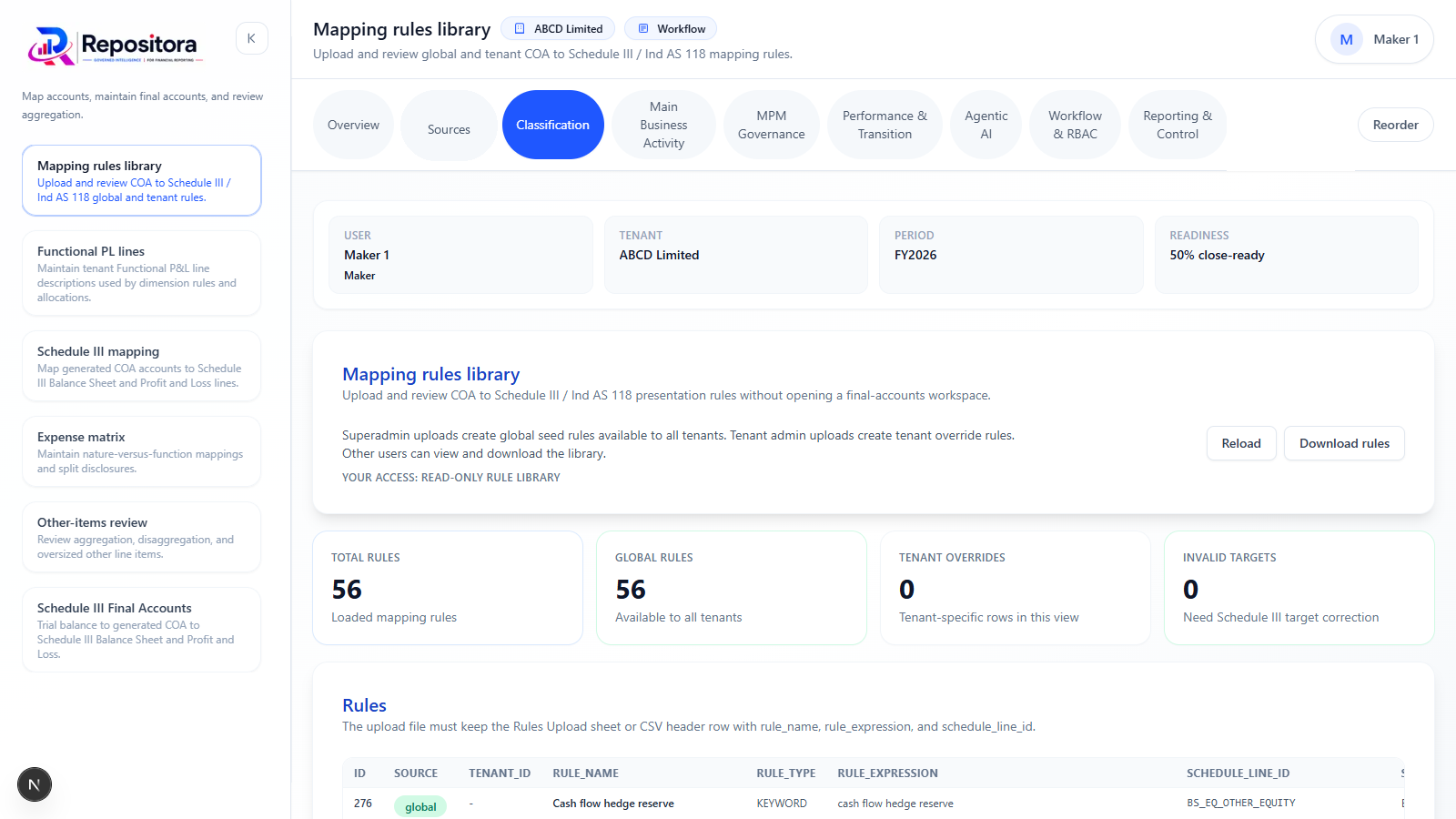
Repositora provides the control baseline on which the rest of the operating model depends. In executable regulatory content and applicability, the most relevant capabilities are a current Ind AS and Schedule III requirements repository, a company-profile questionnaire and standalone applicability checklist, links from requirements to note templates and deterministic validations, and reviewed non-applicability conclusions. Each activity should carry an accountable owner, due date, prerequisite, completion criterion, evidence requirement, reviewer and escalation route. That structure converts a checklist item into an auditable control event.
The reporting foundation should also preserve the approved design from one period to the next while retaining period-specific changes. For example, the current Ind AS and Schedule III requirements repository can establish the standard path, while reviewed non-applicability conclusions make exceptions and progress visible to the appropriate level of management. Local variation can be permitted through controlled additions or waivers, but group-mandated work, evidence and review should remain identifiable. The outcome is not merely better status reporting; it is a complete record of how the reporting conclusion was produced.
The intelligence layer begins where controlled execution leaves off: it connects source data to prioritised human review. For executable regulatory content and applicability, that can include group, entity, standalone and consolidated applicability dimensions, separately versioned current Ind AS, proposed Ind AS 118 and IFRS 18 packs, regulatory change impact during roll-forward, client-specific interpretations separated from global content, and API-accessible requirement and audit objects. The purpose is to automate stable logic, detect departures from expected patterns and route the remaining judgment to the person best placed to resolve it.
Any system-generated output used in executable regulatory content and applicability should retain the source population, rule or model version, confidence or tolerance, exception reason, reviewer response and final disposition. A useful deployment would start with group, entity, standalone and consolidated applicability dimensions, compare results with the existing controlled process and analyse overrides before extending to API-accessible requirement and audit objects. Human approval remains decisive for material classifications, estimates, disclosures and narratives; intelligence should make the basis for judgment clearer, not hide it.
A new rule-pack version modifies an IFRS 18 expense disclosure requirement and adds a validation for operating lines presented by function. When the group opens the next period, the system compares versions and flags the affected note template, specified-expense schedule and two prior applicability conclusions. One subsidiary has no functional expense presentation and remains not applicable; another requires new data fields. The content administrator's approved change record is visible, while each entity's conclusion is stored separately. Finance can explain why the requirement applies and which evidence completes it.
This example separates apparent completion from genuine control. A foundational response would place the current Ind AS and Schedule III requirements repository, company-profile questionnaire and standalone applicability checklist inside a governed workflow with named owners and retained evidence. A connected reporting response could then apply group, entity, standalone and consolidated applicability dimensions and separately versioned current Ind AS, proposed Ind AS 118 and IFRS 18 packs to the stable population, while routing unusual items for review. The performance benefit should be assessed through elapsed time, rework, exception ageing, reviewer effort and the number of late reporting changes. A faster result that cannot be explained or reproduced is not a successful close.
Implementation is strongest when representative complexity is tested early and unresolved exceptions remain visible in one backlog. For executable regulatory content and applicability, the following sequence provides a practical starting point:
Step 1: Define the requirement object, source hierarchy and content licensing approach.
Step 2: Separate accounting-standard, jurisdiction-format and entity-applicability rule layers.
Step 3: Configure explainable triggers, questionnaire outcomes and completion states.
Step 4: Establish technical and professional content-review workflow with versioning.
Step 5: Link requirements to statements, notes, fields, validations and evidence.
Step 6: Pilot period roll-forward and regulatory change impact across multiple rule-pack versions.
Every stage should have an explicit exit criterion supported by approved policy, representative data, completed testing, trained users and resolved high-risk defects. Temporary workarounds should have owners and expiry dates. The programme can then expand coverage on the basis of observed exceptions instead of assumptions made during design.
A scorecard for executable regulatory content and applicability should combine timeliness, quality, control and learning. Useful measures include applicable requirements linked to report objects and required data, engine outcomes overridden without approval, published content changes lacking impact analysis, mandatory disclosures incomplete at final review, time to assess a new regulatory version, and client customisations incorrectly modifying global content. The first two measures-applicable requirements linked to report objects and required data and engine outcomes overridden without approval-should be read together so that apparent speed is not achieved by deferring review or accepting a larger exception population. Trends by entity, workstream, account class or decision type are usually more actionable than a single group average.
The governance model should prevent technical policy, close operations and system configuration from drifting apart by reviewing changes through one controlled decision route. For executable regulatory content and applicability, the forum should agree thresholds, approve policy or rule changes, review aged exceptions and confirm whether improvements have reduced the underlying risk. Decisions should be reflected in the next controlled reporting template and, where relevant, in the governance of connected reporting and automation.
Implementation quality often deteriorates through choices that appear efficient in the short term. Treat as a warning sign presenting licensed or authoritative text without appropriate rights and source control. Resist encoding every judgment as a deterministic yes-or-no rule. Avoid combining global content with client interpretations. Do not rely on rolling forward prior applicability as automatically approved. Challenge using AI-generated summaries as the authoritative requirement. The common pattern is premature optimisation: the team accelerates or automates an activity before it has agreed the definition, ownership, evidence and exception route.
- Who is accountable when requirements are stored as text with no links to data fields, notes or validation logic?
- Can the team demonstrate, for a complete population, that each applicability outcome should display the rule version, triggering facts and user responses?
- What threshold and escalation should govern engine outcomes overridden without approval?
- Which owner maintains the definition and period version of requirement object?
- Which foundational control must be stable before the organisation introduces group, entity, standalone and consolidated applicability dimensions?
Executable regulatory content turns a knowledge repository into a controlled reporting capability without pretending that compliance is fully automatic. The system identifies relevant requirements, explains the triggers, opens the required work and records the professional conclusion. For Repositora, this is a core differentiator: the report, checklist and underlying knowledge can operate as one versioned model rather than three disconnected artefacts. A controlled reporting foundation and a carefully governed intelligence layer make that outcome repeatable rather than dependent on a small number of experts. For executable regulatory content and applicability, the foundation should establish the controlled record, and the intelligence layer should use that record to automate stable work, detect meaningful exceptions and support better decisions. Finance leaders should therefore judge the initiative by the quality of reporting, the transparency of judgment and the resilience of the operating model-not by technology deployment alone.
Official materials checked on 25 June 2026: IFRS Foundation - IFRS 18; issued IFRS 18 text; IFRIC Update - March 2026; ICAI Accounting Standards Board.
This article is educational and does not replace applicable standards, final MCA notifications, professional advice or entity-specific judgment. Product capabilities should be verified against the approved release scope before publication.
Explore how Repositora can connect entity submissions, group reporting, statutory notes, source lineage and Ind AS 118 transition readiness across standalone, group and transition reporting. Visit repositora.com